
The clock is ticking: August 12, 2026
The EU’s Packaging and Packaging Waste Regulation (PPWR) — officially Regulation (EU) 2025/40 — takes full effect on 12 August 2026, and the European Commission has confirmed there will be no delay. This regulation represents the most sweeping overhaul of EU packaging law in three decades, replacing the old Packaging and Packaging Waste Directive 94/62/EC with a directly binding regulation that applies uniformly across all 27 Member States.
For food packaging buyers, the most immediate concern is the PFAS ban in all food-contact packaging, which takes effect the moment the regulation applies — with no grace period for existing stock. Industry estimates suggest only about 10% of companies currently meet PPWR requirements, making supplier readiness the single most critical variable for compliance.
Despite a formal lobbying campaign by 17 German industry associations requesting a postponement to January 2027, EU Environment Commissioner Jessika Roswall explicitly rejected any delay. The Commission published its final Guidance Document and FAQ on 30 March 2026, signaling that the countdown is final.
What the August 2026 deadline actually requires
Several requirements activate simultaneously on August 12, creating a compliance cliff for unprepared businesses.
The PFAS ban
From 12 August 2026, all food-contact packaging must meet three concentration thresholds:
• No more than 25 parts per billion (ppb) for any individual non-polymeric PFAS compound
• No more than 250 ppb for the sum of all non-polymeric PFAS
• No more than 50 parts per million (ppm) of total fluorine
The Commission’s guidance establishes a stepwise testing protocol: first test total fluorine; if below 50 ppm, the packaging passes. If above, further differentiation via pyrolysis-GC/MS is required.
This directly threatens any paper cup, pizza box, burger clamshell, takeaway container, bakery bag, or food wrapper that uses PFAS-based grease-resistant or moisture-barrier coatings — historically one of the most common treatments in the food packaging industry.
Declaration of Conformity (DoC)
Every packaging type placed on the EU market must have a manufacturer-issued Declaration of Conformity following the model in Annex VIII. This legally binding self-declaration must include:
• A unique identification number
• Full manufacturer identification
• Material composition of each component
• The recyclability assessment method used
• An authorized signature
Technical documentation backing the DoC must be retained for 5 years (single-use packaging) or 10 years (reusable), and authorities can demand production of the DoC within 10 days of a request. Generic quality certificates or ISO 9001 documentation do not satisfy this requirement.
Additional August 2026 obligations
• Heavy metals restrictions: combined lead, cadmium, mercury, and hexavalent chromium must not exceed 100 mg/kg
• Packaging minimization: eliminating double walls, false bottoms, and excessive void space
• E-commerce empty space limits: maximum 40%
• Mandatory EPR registration in each Member State where packaged products enter the market
Full PPWR compliance timeline
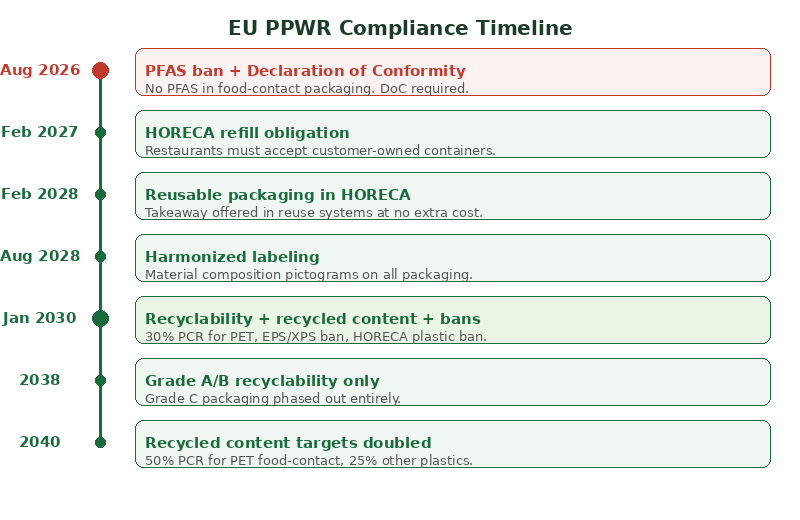
Which food packaging categories face the greatest disruption
Paper and board with PFAS coatings — highest risk
Pizza boxes, burger wrappers, microwave popcorn bags, paper cups with grease-resistant linings, bakery bags, and fast-food clamshells that rely on fluorinated coatings for moisture or grease resistance must reformulate immediately. There is no grandfathering — even packaging manufactured before August 2026 cannot be sold after the deadline if it exceeds PFAS limits.
Alternatives include water-based dispersions, natural wax and mineral barriers, bagasse (sugarcane fiber) containers with internal sizing, and kraft paper with PFAS-free barrier treatments.
Single-use plastic containers for HORECA
Cups, plates, trays, and boxes used for food consumed on premises face an outright ban from January 2030. The regulation defines “plastic” as any packaging where plastic content is 5% or more by weight (excluding labels, varnishes, and inks), meaning paper cups with standard plastic linings may be classified as plastic packaging.
EPS and XPS food containers
The PPWR adds XPS to the existing EPS prohibition for ready-to-eat food and beverages, closing a gap in the Single-Use Plastics Directive.
PET food trays and containers
Must incorporate 30% post-consumer recycled content by 2030 and 50% by 2040. Given the scarcity of food-grade recycled PET, this creates significant sourcing pressure.
What food packaging buyers should demand from suppliers now
The PPWR shifts compliance from a regulatory checkbox to a supply chain partnership. Buyers who fail to pressure suppliers now risk receiving non-compliant stock that cannot legally enter the EU market after August 12.
1. PFAS verification
Request total fluorine test reports for every food-contact packaging SKU. If any result exceeds 50 ppm, further targeted PFAS analysis is required. Suppliers who cannot provide test documentation should be flagged for replacement. Demand material-level confirmation that no PFAS-based coatings, treatments, or additives are present in any packaging component, including inks, adhesives, and barrier layers.
2. Declaration of Conformity
Every supplier must produce a valid DoC per packaging type, following the Annex VIII template. A company purchasing 50 different packaging formats needs 50 separate DoCs. Reject generic compliance certificates or marketing claims as substitutes.
3. Supplier readiness checklist
• Mono-material design capability: Can the supplier produce packaging from a single recyclable material?
• PCR content roadmap: Does the supplier have a credible path to meeting 10-30% recycled content by 2030?
• Labeling readiness: Can the supplier support harmonized EU pictograms (required by August 2028)?
• Third-party certifications: RecyClass for recyclability, ISCC PLUS for recycled content chain of custody, FSC for paper products
• Change notification protocols: Does the supplier commit to alerting buyers when material composition changes?
How the regulation reaches beyond EU borders
The PPWR applies to all packaging placed on the EU market, regardless of country of manufacture. Chinese and other non-EU manufacturers exporting food packaging to the EU bear the same compliance obligations as European producers.
For non-EU manufacturers, the most immediate challenges are:
• Reformulating to PFAS-free alternatives and providing test documentation
• Issuing Declarations of Conformity for every packaging type
• Appointing an EU Authorized Representative in each Member State where products first enter the market
• Supporting EU importers with verification documentation
If an EU importer’s name or brand appears on the packaging, that importer becomes the legal “manufacturer” under the PPWR and must issue the DoC themselves. Online marketplaces must verify seller EPR registration numbers and can block listings where registration is missing.
The practical effect is that non-EU suppliers who cannot provide PPWR-compliant documentation risk losing EU market access entirely, as importers and marketplaces increasingly screen for compliance capability.
Penalties create real enforcement teeth
The PPWR mandates that each Member State establish “effective, proportionate, and dissuasive” enforcement measures:
• Germany: fines of up to €200,000 plus sales bans
• France: fines of up to €100,000 per violation with possible imprisonment for repeated offenses
• Market surveillance authorities can order product withdrawal and recall
• Customs authorities can detain shipments at EU borders
• Online marketplaces may delist sellers lacking valid EPR registration
How GQTH Pack helps you stay compliant
At GQTH Pack, we understand that EU PPWR compliance isn’t just about checking boxes — it’s about having a packaging supplier who stays ahead of the regulations so you don’t have to.
Here’s what we offer our EU-bound customers:
• PFAS-free materials by default: All our food-contact paper cups, bags, and containers use water-based barrier coatings — no fluorinated treatments
• Full Declaration of Conformity: We provide DoC documentation per Annex VIII for every packaging format we produce
• Material test reports: Total fluorine and heavy metals testing available on request
• Recyclable mono-material options: We offer PE-lined paper cups, uncoated kraft bags, and bagasse containers designed for EU recycling streams
• Custom printing with compliant inks: Our printing uses food-safe, low-migration inks compatible with recycling requirements
Whether you’re a restaurant chain, a food brand, or a distributor importing into the EU, we can help you navigate the transition. Get in touch for a free compliance consultation and quote.